Every listing, graded — and auditable.
Short version: every listing on marocain.investments ships with four signals — a Window-View Score, a Structural Quality score, a Macro-Catalyst score and an M-Value AVM — folded into one cohort-relative {GIN} verdict against other listings of the same typology in the same city. None of them are magic; all of them are auditable. Each carries the methodology label that produced it and a 0–1 confidence value that drops when the data is thin. Below: exactly what each score measures, how to read the bands — and, just as importantly, what each score is NOT.

Four scores on every listing.
Each grades a different thing, on a different method, with its own honesty clause. Read them together — none of them is the whole story on its own.
Window-View Score
A vision model scores the actual view from the primary living spaces — ocean, medina, skyline or garden — from the listing photos. Marketing-staged dusk shots don't earn a higher score than the underlying property warrants.
Structural Quality
Build era, finishes and visible condition, read from the photos. 90+ is a 2020+ build with designer or branded finishes; 70–89 is a 2010–2019 build or a restored heritage envelope; below 50 is cosmetic-tier needs-work.
Macro-Catalyst
A sourced, per-city read of the funded macro forces repricing that market — Tanger Med port expansion, the Kenitra battery gigafactory, Casablanca Finance City, OCP, the TGV corridor, the Abraham Accords and World Cup 2030 build-out. Each city's score carries a URL trail to the underlying commitment, not a distance-to-stadium proxy.
M-Value AVM
A median-of-comparables valuation built from the catalogue itself: listings in the same district + typology + ±20% surface, median price per m², applied to the target's surface. The band is 1.5σ on the comp dispersion.
The rubric, in full.
What each score measures, how to read the bands, and what it explicitly is NOT. This is an internal grading rubric — not an external market dataset.
| Score | What it measures | Bands / how to read it | What it is NOT | Range |
|---|---|---|---|---|
| Window-View Score | A vision model scores the actual view from the primary living spaces — ocean, medina, skyline or garden — from the listing photos. Marketing-staged dusk shots don't earn a higher score than the underlying property warrants. | 90+ = dominant Atlantic / Mediterranean frontage from multiple rooms · 70–89 = a substantial sea or skyline glimpse · 50–69 = garden or courtyard view. | Not a guarantee the view is protected — a vision read of today's photos, not a planning-permission check on what could be built across the street. | 0–100 |
MethodologyWhat it measures: vision-v1 (gemini-2.5-flash) · 2026.06 | ||||
| Structural Quality | Build era, finishes and visible condition, read from the photos. 90+ is a 2020+ build with designer or branded finishes; 70–89 is a 2010–2019 build or a restored heritage envelope; below 50 is cosmetic-tier needs-work. | 90+ = recent build, designer / branded finishes · 70–89 = solid 2010s build or restored heritage · below 50 = visible work needed. | Not a structural survey or a notary inspection. It is a triage signal — which listings warrant the flight in — not a verdict on the foundations. | 0–100 |
MethodologyWhat it measures: condition-v1 (gemini-2.5-flash) · 2026.06 | ||||
| Macro-Catalyst | A sourced, per-city read of the funded macro forces repricing that market — Tanger Med port expansion, the Kenitra battery gigafactory, Casablanca Finance City, OCP, the TGV corridor, the Abraham Accords and World Cup 2030 build-out. Each city's score carries a URL trail to the underlying commitment, not a distance-to-stadium proxy. | Higher = more funded macro tailwind behind the city (Tangier and Kenitra lead; Casablanca and Rabat follow). It is exposure at the city level, not a per-street promise. | It quantifies catalyst exposure — it does NOT predict appreciation. A funded pipeline is a tailwind, not a price forecast. | 0–100 |
MethodologyWhat it measures: catalyst-v2 (sourced city ledger) · 2026.06 | ||||
| M-Value AVM | A median-of-comparables valuation built from the catalogue itself: listings in the same district + typology + ±20% surface, median price per m², applied to the target's surface. The band is 1.5σ on the comp dispersion. | Renders only with ≥3 comparables — under that the chip simply doesn't show. The vs-asking delta is most useful past >8% above or below the comp median. | Decision-support, not a formal valuation. We would rather show nothing than a noisy number on a thin comp pool. | estimate + band |
MethodologyWhat it measures: m-value-v1 (median-of-comparables) · 2026.06 | ||||
Methodology + confidence.
No black box. Every score tells you how it was produced and how sure it is — so you can weigh it, not just trust it.
A methodology label on every score
Each score ships with the exact method that produced it — e.g. vision-v1 (gemini-2.5-flash) for the view, condition-v1 for finishes, a sourced city ledger for the Macro-Catalyst, and median-of-comparables for the M-Value. If a score reads v1.deterministic, it was NOT model-graded.
A 0–1 confidence value that drops with thin data
Confidence falls when the source data is thin — fewer than three photos, missing coordinates, missing surface. A low confidence value is the model being honest about what it could and couldn't tell, not a hidden penalty.
Silence over a noisy number
When a signal can't be produced honestly — a comp pool under three rows, for instance — the chip simply doesn't render. We would rather show nothing than a number we can't stand behind.
What the scores tell you — and what they don't.
The honest ledger. The scores are a fast, auditable triage layer; they are not a survey, a valuation, or advice — and the page says so plainly.
- Which listings warrant the flight in — a fast, consistent triage across the whole catalogue.
- How a property reads on view and finishes from its own photos, on the same rubric every time.
- Its catalyst exposure and a comp-based sense of value — each with the confidence to weight it by.
- Not a structural survey or a notary inspection — Structural Quality is a photo-based triage signal, full stop.
- Not a formal valuation — the M-Value AVM is decision-support, and renders only with ≥3 comparables.
- Not investment advice, and not a price forecast — the Macro-Catalyst quantifies sourced city-level exposure, not appreciation.
A grade is only worth as much as the method behind it. So every score on marocain.investments shows its working — the model that produced it, the band you're reading, and how confident it is given the data. Use the scores to decide which listings warrant a closer look; use a surveyor, a notary and an agent for the things a photo-read can't settle. That's the whole contract: fast and auditable, never pretending to be certified.
Decision-support, not a certified appraisal or investment advice. The M-Value AVM renders only with ≥3 comparables; confidence drops on thin data.
How the grading works — straight answers.
AI listing grading on marocain.investments is an internal rubric that scores every property on view, structural quality and sourced macro-catalyst exposure, plus a median-of-comparables M-Value — folded into one cohort-relative {GIN} verdict, each with a methodology label and a 0–1 confidence value, as decision-support rather than a certified appraisal.
How does marocain.investments grade a listing?
Every listing ships with four signals: a Window-View Score (0–100, a vision model on the actual view), a Structural Quality score (0–100, build era and finishes read from the photos), a Macro-Catalyst score (0–100, a sourced per-city read of the funded forces repricing that market) and an M-Value AVM — a median-of-comparables valuation. They fold into one cohort-relative {GIN} verdict, scored against other listings of the same typology in the same city. Each score carries a methodology label and a 0–1 confidence value, so the read is auditable rather than a black box.
Does the AI score replace a structural survey or a valuation?
No. The Structural Quality score is a photo-based triage signal — which listings warrant a closer look — not a substitute for a structural survey or a notary inspection. The M-Value AVM is decision-support, not a formal valuation. Both are explicitly stated as what they are NOT on every listing.
What does the Macro-Catalyst score actually tell me?
It is a sourced, per-city read of the funded macro forces repricing that market — Tanger Med, the Kenitra gigafactory, Casablanca Finance City, OCP, the TGV corridor, the Abraham Accords and the World Cup 2030 build-out — each with a URL trail to the underlying commitment. A higher score means more funded tailwind behind the city. It does NOT predict appreciation: treat it as exposure, not a price forecast.
Why doesn't every listing show an M-Value?
The M-Value AVM only renders when there are at least three genuine comparables in the same district, typology and ±20% surface band. Below that threshold the comp pool is too thin to be honest, so the chip simply doesn't show — we would rather display nothing than a noisy number.
What is the confidence value next to a score?
Each score ships with a methodology label (for example vision-v1 (gemini-2.5-flash)) and a 0–1 confidence value. Confidence drops when the source data is thin — fewer than three photos, missing coordinates, missing surface. The number you see is honest about what the model could and couldn't tell from the available data.
Field notes on the method.
The deep-dives behind the rubric — how each score is built and where its limits are.

What the marocain.investments scores are NOT — the honest list
The scores are a relative quality-and-deal signal computed from listing data. Useful for triage. Not a regulated document, not a forecast, not a substitute for the notaire, the expert-évaluateur, the architect or the bank's appraiser. Here is the explicit list of what the rubric will NOT do for you.

Confidence calibration: what high / medium / low means on a score chip
A score chip is only as honest as the data behind it. marocain.investments rates overall confidence 'high' only when all three pillars (Window-View, M-Value AVM, WC 2030 Catalyst) resolve against primary data — and SUPPRESSES the chip rather than fabricate one if any pillar fails. Here is exactly what drops each pillar.

How marocain.investments scored one real listing, end-to-end
Every listing runs through the same four-pillar rubric: Window-View Score (Gemini 2.5 Flash vision over the listing's own photos), Structural Quality (deterministic build-era + finishes proxy), Macro-Catalyst (a sourced per-city read of funded macro forces: Tanger Med, the Kenitra gigafactory, CFC, OCP, the Abraham Accords and the WC 2030 build-out), and the M-Value AVM (district + typology + ±20% surface comparables). Fused into a {GIN} Quality verdict and a {GIN} Deal verdict — with the methodology label exposed at /api/public/listings/$id.
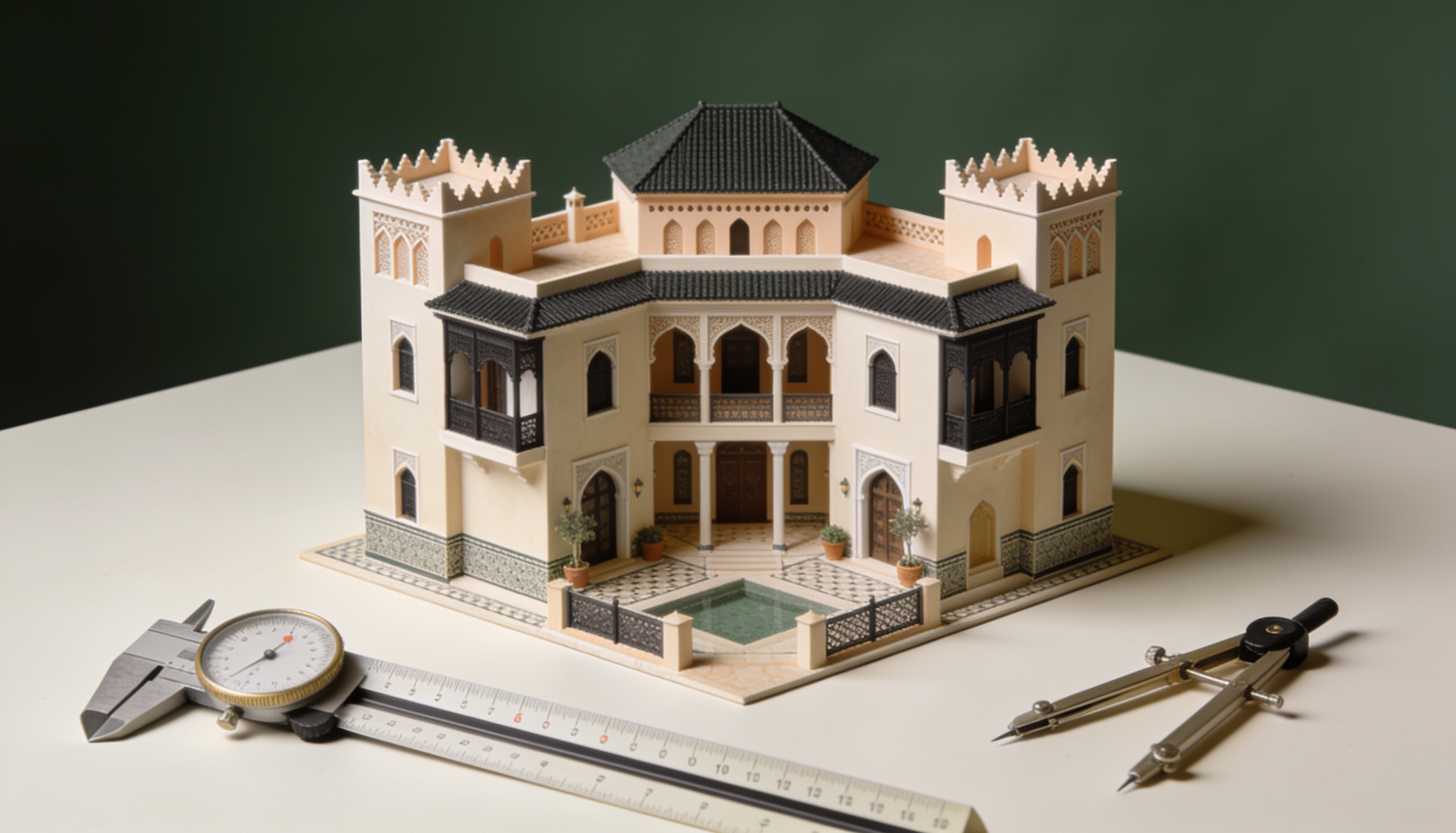
M-Value AVM under the hood: how marocain.investments values a listing
The M-Value chip on every listing is an Automated Valuation Model — the median price/m² of district + typology + ±20%-surface comparables, with a ±1.5σ confidence band, requiring ≥3 comparables or it doesn't render at all. Here's exactly how the comparable pool is built, why we use the median, what the vs-asking delta tells you, and — honestly — what an AVM is NOT.