Own it, fund it, get your money back out.
Buying property in Morocco as a foreigner is well-defined, not mysterious: you get full freehold title, you move money through one sanctioned channel, and — if you keep the paper trail — you can take your capital and your gain back out. Five steps, every cost sourced below: open a convertible-dirham FCR account, wire foreign currency at the Bank Al-Maghrib rate, complete the notary and titre foncier registration, pay the taxes and fees, then repatriate proceeds via the FCR trail.
The five steps, in order.
Each step has a governing body and a paper artefact. Get the artefacts right and the back-out at sale takes care of itself. Forward-looking timelines are indicative.
Open a convertible-dirham (FCR) account
Every foreign buyer routes purchase capital through a compte en dirhams convertibles, registered with the Office des Changes. It is the only sanctioned door for EUR/USD/GBP into Moroccan real estate — and the only way to preserve the right to repatriate proceeds when you later sell. Attijariwafa, Bank of Africa, CIH and Société Générale Maroc all run them.
Wire foreign currency at the Bank Al-Maghrib rate
Send your foreign currency into the FCR account. The bank converts at the Bank Al-Maghrib mid-rate plus a transparent spread (≈ 0.6–1.2%). Keep the original wire receipt — it is the first document in the paper trail that lets you take capital and gain back out.
Notary + titre foncier registration
A Moroccan notaire (notaire) handles the deed. Funds move from your FCR account to the notary's escrow (compte séquestre), then to the seller after the acte de vente is signed. Registration on the titre foncier (the land-title register) makes ownership conclusive and publicly recorded.
Pay the taxes & fees
Budget for registration (transfer) duty of 4% (residential resale) plus notary, title and stamp fees — together roughly 8–12% all-in on a resale. Recurring local taxes (taxe d'habitation / taxe de services communaux) apply after you own. See the full table below, each line sourced.
Repatriate proceeds via the FCR paper trail
When you sell, capital-gains tax (TPI) is 20%, with a minimum of 3% of the sale price; a primary residence occupied 5+ years (sale price < 4,000,000 MAD) is exempt. The Office des Changes lets non-residents who invested in convertible dirhams take the capital and the gain back out — provided the original FCR wire, notary attestation and titre foncier file line up.
What it actually costs.
Registration, closing, capital-gains and repatriation — each line sourced to the DGI, the Office des Changes or Bank Al-Maghrib. The all-in range is indicative; confirm against the cited source and a notaire.
| Item | Rate | Notes |
|---|---|---|
| Registration (transfer) duty | 4% | —Droits d'enregistrement on the purchase price, paid at registration of the deed. |
SourcesRate: Code Général des Impôts (DGI) · 2024 | ||
| All-in closing costs | ≈ 8–12%· indicative | —Registration duty + notary fees + land-title registration + stamp duty, combined. The exact total depends on price and the notaire's scale. |
SourcesRate: DGI / notaire fee scales (marocain.investments synthesis) · 2024 | ||
| Capital-gains tax (TPI) | 20% (min 3%) | —Taxe sur le profit immobilier on the gain, with a floor of 3% of the sale price. A primary residence occupied 5+ years (sale price < 4,000,000 MAD) is exempt. |
SourcesRate: Code Général des Impôts (DGI) · 2024 | ||
| Local annual taxes | Variable | —Taxe d'habitation + taxe de services communaux, assessed on rental value; new builds get a multi-year exemption. Modest for most residences. |
SourcesRate: Code Général des Impôts (DGI) — local taxes · 2024 | ||
| FCR repatriation | Guaranteed* | —Non-residents who invested via convertible dirhams may repatriate capital and gain — subject to the FCR paper trail (wire receipt, notary attestation, titre foncier). |
SourcesRate: Office des Changes · 2024 | ||
Foreign ownership & residency.
What you can and can't own — and how a purchase supports a residence permit without granting one automatically.
- Freehold (full titre foncier title) on residential property — the same ownership a Moroccan holds.
- Commercial property and apartments in urban perimeters, with no special permit.
- Property that supports a renewable residence-permit (carte de séjour) application — evidence of ties and accommodation.
- Agricultural land outside urban perimeters generally cannot be bought by foreigners.
- Ownership does not auto-grant residency or citizenship — it supports, it doesn't confer.
- Some new developments price in VAT differently — confirm the tax treatment per project with the notaire.
What's genuinely straightforward — and what adds friction.
The honest ledger. Most of the process is well-trodden; a few steps add real lead time, and a serious guide says where.
- Foreigners get full freehold title — no nominee structures, no leasehold workarounds.
- Costs are published: 4% registration duty, ~8–12% all-in closing, 20% TPI on the gain.
- The notaire and titre foncier system makes ownership conclusive and publicly recorded.
- The convertible-dirham (FCR) account adds roughly 3–6 weeks of lead time over a domestic buy.
- Repatriation depends entirely on keeping the paper trail — lose a document and the back-out gets harder.
- KYC, tax-ID issuance and cross-border wires can stall; budget two to three months end-to-end.
There is no trick to buying in Morocco as a foreigner — there is a sequence. Get full title, move money through the one sanctioned channel, keep every receipt, and the exit is as clean as the entry. The cost is known up front, the restriction (farmland) is narrow, and the repatriation right is real for anyone who used convertible dirhams. The only thing that catches people out is the paperwork lead time — so start the plan before you fall for the property.
Decision-support, not legal, tax or investment advice. Figures and timelines are indicative — verify against the cited source and a notaire.
Buying in Morocco — straight answers.
The foreign buyer's playbook is the sequenced legal and financial process by which a non-resident acquires Moroccan property: routing capital through a convertible-dirham (FCR) account, completing notary and titre foncier registration, paying registration duty and taxes, and preserving the right to repatriate proceeds.
Can foreigners legally buy property in Morocco?
Yes. Non-residents can own freehold (full title) residential and commercial property in Morocco with no special permit — the same titre foncier ownership a Moroccan holds. The one restriction is agricultural land outside urban perimeters, which generally cannot be bought by foreigners. This is decision-support, not legal advice; confirm your specific case with a notaire.
How do I get my money into — and back out of — Morocco?
You route purchase capital through a compte en dirhams convertibles (FCR account) registered with the Office des Changes, wired in at the Bank Al-Maghrib rate. Keeping that paper trail — wire receipt, notary attestation, titre foncier — is what preserves your right to repatriate the capital and the gain when you sell. Skip it and you may hold dirhams you cannot easily move home.
What does it cost to buy property in Morocco as a foreigner?
Registration (transfer) duty is 4% of the price for residential resale (a preferential 2.5% on a developer new-build first sale; 6% for commercial premises and building/bare land, 5% for agricultural land). Add notary, title-registration and stamp fees and the all-in closing cost is roughly 8–12% — an indicative range that varies with price. On a later sale, capital-gains tax (TPI) is 20% with a minimum of 3% of the sale price, and a primary residence occupied 5+ years is exempt.
Does buying property give me residency in Morocco?
Property ownership does not automatically grant residency, but it strongly supports a residence-permit (carte de séjour) application — owning a home is evidence of ties and accommodation. Morocco offers renewable residence permits to non-residents who can show means and a place to live. See /legal/residency for the route; treat timelines as indicative.
How long does the whole process take?
Opening the FCR account and clearing KYC typically takes 5–15 business days; the notary and titre foncier registration add a few weeks. The convertible-dirham channel adds roughly 3–6 weeks of lead time over a domestic purchase. Budget two to three months end-to-end for a clean, fully-documented foreign purchase.
Field notes for buyers.
Sourced, adversarially fact-checked deep-dives on the channel, the costs and the catalysts — every figure carries its source.
Residency by property investment in Morocco — the realistic foreign-buyer path
Owning a Moroccan property does not grant residency. Morocco has no fast-track 'golden visa' like Portugal or Greece — the carte de séjour route is the standard prefecture dossier under Loi 02-03, with property serving as proof of address, not a basis. Here is the realistic ladder (1 → 3 → 5 or 10 years), the dossier, the IF/FCR paper trail, and how a foreign owner actually gets to live in their home.
All-in closing costs in Morocco: the foreign buyer's real envelope
The headline closing stack for a foreign cash buyer of a Moroccan resale property — registration duty 4% (DGI), land conservation ~1% (ANCFCC), notary honoraires on a sliding scale (~1% to 0.25%) + 20% VAT, plus the technical bank FX spread on the FCR wire-in. All-in: roughly 6.5–8.5% of price before any agency commission.
Capital-gains tax (TPI) for foreign sellers of Moroccan property
When a foreigner sells Moroccan property, Taxe sur le Profit Immobilier (TPI) is withheld at source by the notaire — 20% of the gain, with a minimum of 3% of the sale price. A primary-residence exemption kicks in after 6 years, but it requires conditions most foreign buyers don't meet. The TPI paper trail interlocks with the FCR repatriation file — get it wrong and capital can get stuck in dirhams.
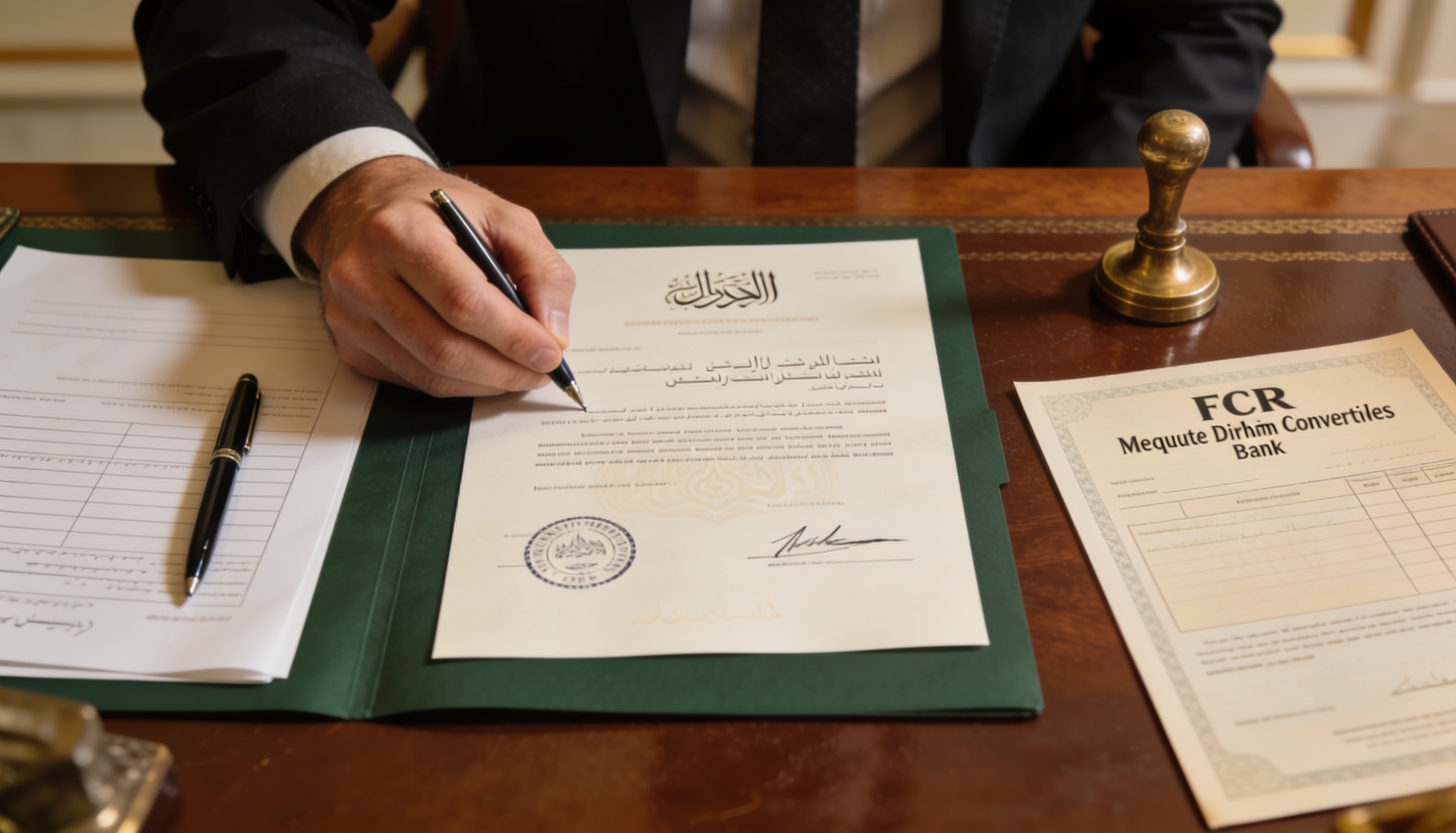
The FCR account, step by step: how a foreign buyer opens it in Morocco
The compte en dirhams convertibles (FCR) is the only Office des Changes-sanctioned channel that lets foreign capital into Moroccan property and back out again. Here is the practical playbook — banks (Attijariwafa, Bank of Africa, CIH, Société Générale Maroc), KYC + Identifiant Fiscal, the Bank Al-Maghrib reference rate, the notary's compte séquestre, and the Bordereau de Change you need at exit.