The FCR account, step by step: how a foreign buyer opens it in Morocco
The compte en dirhams convertibles (FCR) is the only Office des Changes-sanctioned channel that lets foreign capital into Moroccan property and back out again. Here is the practical playbook — banks (Attijariwafa, Bank of Africa, CIH, Société Générale Maroc), KYC + Identifiant Fiscal, the Bank Al-Maghrib reference rate, the notary's compte séquestre, and the Bordereau de Change you need at exit.
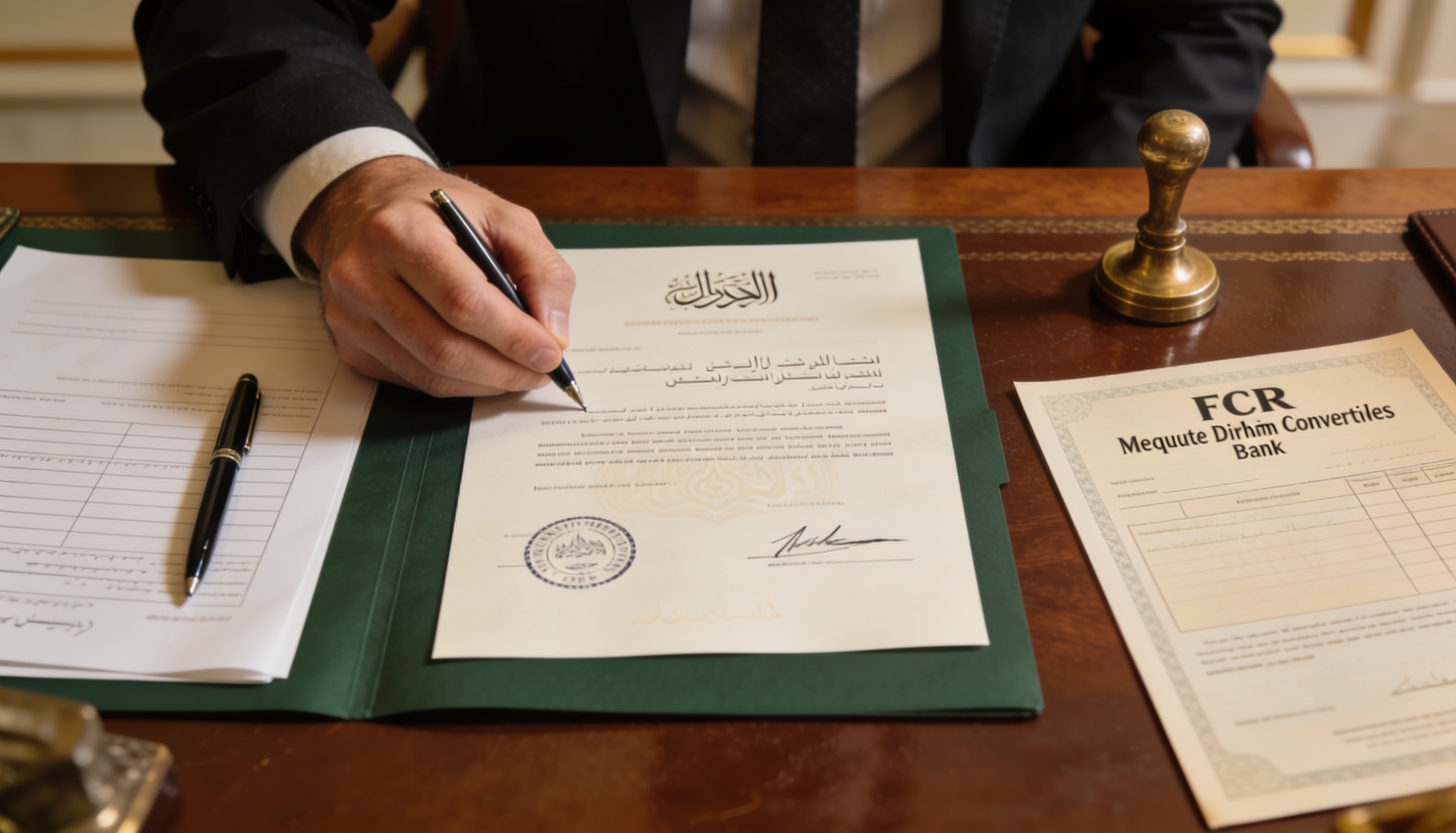
What an FCR account is, and why a foreign buyer needs one
A compte en dirhams convertibles (FCR) is a Moroccan-dirham account that can only be funded from foreign currency, and whose balance — plus any investment proceeds traceable to it — can be transferred back out without prior Office des Changes (OC) authorisation. It is open to foreign individuals (resident or non-resident) and to foreign legal entities. Credits must come from a foreign-currency sale on the FX market, a foreign-currency account, or another convertible-dirham account — you cannot top it up from local MAD. That funding rule is the whole point: it builds the paper trail that lets you take money back out at exit.
Which banks run them
The mainstream options for a foreign buyer are Attijariwafa Bank, Bank of Africa (ex-BMCE), CIH Bank, and Société Générale Maroc — Bank of Africa publishes a dedicated FCR product page; the others run it as a standard non-resident product.
Opening it: KYC and the Identifiant Fiscal
KYC for a non-resident is straightforward: valid passport, proof of foreign address, and documentation of the Morocco connection (typically the property purchase file or a business). In parallel, the Direction Générale des Impôts (DGI) issues the Identifiant Fiscal (IF) — Morocco's tax ID; a non-resident with a Moroccan economic presence files a *déclaration d'existence* within 30 days of establishment.
Account opening usually takes a few business days once KYC clears; the IF runs days to a few weeks. Both are *indicative* — no bank or the DGI publishes an SLA.
The wire-in: the BAM reference rate and the bank spread
Bank Al-Maghrib publishes the average reference (mid) exchange rate of the dirham daily at 16:15 local time (14:00 during Ramadan), based on interbank transactions. The dirham trades inside a ±5% fluctuation band around a central rate computed 60% EUR / 40% USD (since 9 March 2020).
On the wire-in, the commercial bank quotes a spread around the BAM mid; in practice that spread runs roughly 0.5%–1.5% depending on bank and ticket size (indicative — banks do not publish it). Worth negotiating on a six-figure transfer.
The notary's compte séquestre
The notaire takes the customary 10% deposit and the balance into a compte séquestre (escrow) — in practice often parked at the Caisse de Dépôt et de Gestion (CDG) — until the deed is registered at ANCFCC. Critically, the funds must arrive through a Moroccan bank account and be documented — that is what preserves your right to repatriate capital on resale. An FCR is the cleanest vehicle for that.
The Bordereau de Change — the document that matters at exit
When the wire lands, the Moroccan bank issues a "Formule Unique" / "Bordereau de Change". This is the legal proof — recognised by the Office des Changes — that capital entered Morocco in foreign currency. Without it, you do not repatriate sale proceeds or gains. File it. Keep two copies.
Exit: the repatriation file
The OC "Investment Income Transfer — NRF" regime guarantees free transfer abroad of income and capital from foreign-currency-funded investments, conditional on the original FCR / foreign-currency funding trail. At resale, the file your Moroccan bank submits to OC is, in practice, four documents: the notarised sale deed, the tax-clearance certificate (TPI withheld at source by the notaire), the original Bordereau de Change for the inbound wire, and the bank's repatriation request.
The honest ledger
What this proves:
- The FCR channel is the canonical Office des Changes-recognised vehicle for foreign capital into Moroccan property and back out.
- The downstream repatriation right is built up-front through the Bordereau de Change and the bank-account paper trail — not negotiated at exit.
What it still requires you to confirm with your chosen bank/notaire:
- Bank spread on the wire-in (no bank publishes it; ~0.5–1.5% is a range, not a quote).
- KYC and IF opening lead-times (a few days to a few weeks — indicative).
- Whether your notaire parks escrow at CDG or another seguestre — practice varies.
*Sourced to Office des Changes, Bank Al-Maghrib, DGI and named bank/notary sources, and adversarially fact-checked — one correction applied: the dirham fluctuation band is ±5% (since 9 March 2020), not ±7.5%. Analysis, not legal or tax advice — confirm specifics with your Moroccan notaire and bank.*
What is an FCR account?
A compte en dirhams convertibles — a Moroccan dirham account that can only be funded from foreign currency, and whose balance plus traceable proceeds can be repatriated without prior Office des Changes authorisation. It is open to foreign individuals (resident or non-resident) and foreign legal entities.
Which banks open FCR accounts in Morocco?
Attijariwafa Bank, Bank of Africa (ex-BMCE), CIH Bank and Société Générale Maroc. Bank of Africa publishes a dedicated FCR product page; the others handle it as a standard non-resident product.
What do I need to open one?
A valid passport, proof of foreign address, documentation of the Morocco connection (typically the property purchase file), and Morocco's tax ID — the Identifiant Fiscal (IF), issued by the DGI. Non-residents with a Moroccan economic presence must file a déclaration d'existence within 30 days of establishment. Account opening runs a few business days; the IF runs days to weeks — both indicative.
What rate will the bank convert at?
Bank Al-Maghrib publishes the daily reference (mid) rate at 16:15 local time (14:00 during Ramadan); the dirham trades in a ±5% band around a 60% EUR / 40% USD basket (since March 2020). Commercial banks quote a spread around that mid on the wire-in — roughly 0.5–1.5%, indicative and worth negotiating on larger tickets.
What document do I absolutely need to keep for repatriation?
The Bordereau de Change (also called the Formule Unique) — issued by the Moroccan bank when the inbound wire lands. It is the Office des Changes' recognised proof that capital entered Morocco in foreign currency. Without it, sale proceeds and capital gains cannot be repatriated.