Water and desalination: the constraint Morocco's growth must clear
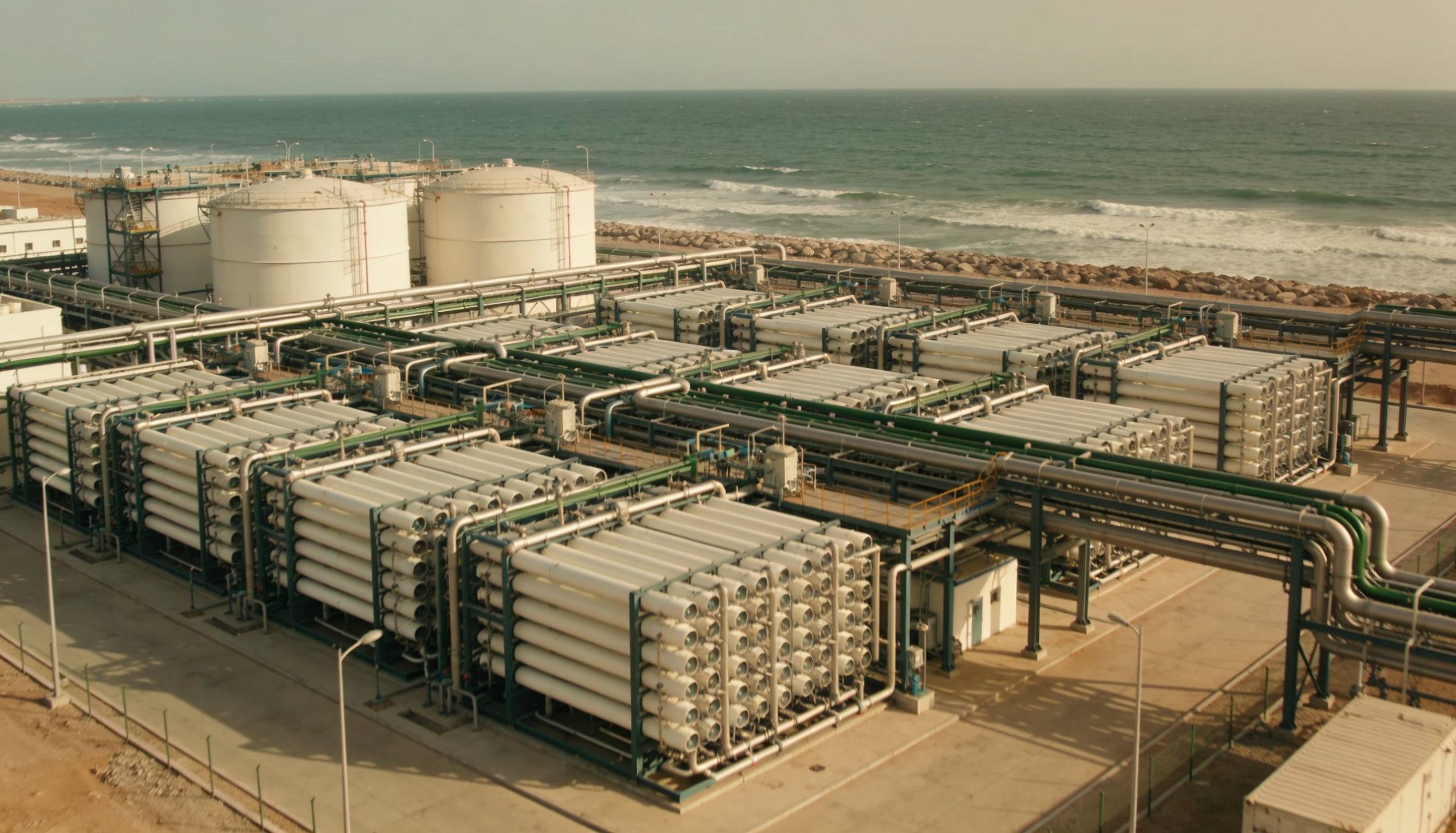
Morocco is structurally water-stressed (~600 m³ per person a year, near the absolute-scarcity line). Its answer is the largest desalination build-out in Africa — a ~MAD 143bn water programme, the Casablanca mega-plant, and a target of roughly half of drinking water from desalination by 2030. This is the enabling — and binding — layer beneath every other engine: industry, green hydrogen and agriculture all need the water to arrive.
The constraint, stated plainly
Morocco's diversification story has one binding input: water. The country has roughly 600 m³ of renewable water per person per year — below the 1,000 m³ "water-stress" line and approaching the 500 m³ "absolute scarcity" threshold (World Bank / HCP framing). Industry, green hydrogen and irrigated agriculture all assume the water shows up. So the desalination programme is not a side-project — it is the layer the rest of the thesis sits on.
The programme
The National Programme for Drinking Water Supply and Irrigation (2020–2027) is budgeted at roughly MAD 143 billion, with desalination as its spine. The stated national ambition is to source around half of drinking water from desalination by 2030, scaling national desalination capacity toward ~1.7 billion m³/year across roughly twenty plants (these 2030 figures are official targets — indicative until delivered).
The anchor plants
- Casablanca — designed to be Africa's largest desalination plant, phasing in around 300 million m³/year toward ~548 million m³/year, powered by dedicated wind, with first water targeted around 2026–2027.
- Agadir — already operating since 2022, serving drinking water and the Souss-Massa agricultural belt.
- Dakhla — a solar-powered plant feeding a new irrigated agricultural zone in the Atlantic south.
- OCP — a separate ~560 million m³/year industrial desalination programme that decouples the phosphate complex from freshwater.
What it means — and the honest read
Done, this de-risks everything else: it lets the Atlantic-south green-hydrogen projects, the coastal industry and the cities grow without draining aquifers. But it is the engine with the most execution risk: desalination is energy-intensive and costly, which is precisely why it is being tied to the renewable build-out — one ambitious programme leaning on another. Treat the 2030 capacity targets as commitments, not delivered capacity.
For property, water security is indirect but foundational: the cities and industrial zones that secure desalinated supply (Casablanca, Agadir, Dakhla, Laâyoune) are the ones whose growth is not capped by drought. It is an enabling condition for demand, not a price signal on its own.
The honest ledger
What it proves:
- Morocco has a funded, large-scale, named-plant desalination programme (Casablanca, Agadir, Dakhla, OCP) — not just a target.
- It explicitly ties water to renewables, decoupling industrial and urban water from freshwater and agriculture.
What it still has to prove:
- Delivery of the 2030 capacity (~1.7 bn m³/yr) and the ~50%-from-desalination goal — these are official targets.
- That the energy cost of desalination is absorbed without raising water tariffs in a way that bites households or industry.
- Any direct property-price effect — water security enables demand; it does not, by itself, move prices.
*Editor-authored and sourced to official programmes (Ministry of Equipment & Water / ONEE / OCP); the automated fact-check pass was session-limited, so 2030 capacity and percentage targets are flagged indicative. Analysis, not investment advice.*
How water-stressed is Morocco?
Severely — roughly 600 m³ of renewable water per person per year, below the 1,000 m³ water-stress line and approaching the 500 m³ absolute-scarcity threshold. Water is the binding input for industry, green hydrogen and irrigated agriculture.
What is Morocco's desalination plan?
The 2020–2027 National Water Programme (~MAD 143 billion) makes desalination its spine, targeting roughly half of drinking water from desalination by 2030 and national capacity toward ~1.7 billion m³/year across about twenty plants. Those 2030 figures are official targets.
What is the Casablanca desalination plant?
It is designed to be Africa's largest, phasing in around 300 million m³/year toward ~548 million m³/year, powered by dedicated wind, with first water targeted around 2026–2027. Agadir (since 2022) and a solar-powered Dakhla plant are other anchors.
Why does water matter for the diversification thesis?
Because every other engine assumes it. Industry, the Atlantic-south green-hydrogen projects and irrigated agriculture all need water to arrive; desalination — tied to the renewable build-out — is the enabling layer the rest of the case sits on, and its biggest execution risk.
Does water security affect property?
Indirectly. Cities and industrial zones that secure desalinated supply (Casablanca, Agadir, Dakhla, Laâyoune) are the ones whose growth is not capped by drought — an enabling condition for real-estate demand, not a price signal on its own.