Morocco's automotive engine: Tangier, Kenitra and EV batteries
Morocco built ~560,000 vehicles in 2024 — level with South Africa, and reporting puts it overtaking in 2025 — anchored by Renault Tangier and Stellantis Kenitra. Automotive is now the #1 export sector (~€15bn), and an EV-battery chain (Gotion gigafactory, COBCO precursors) is forming around Kenitra. For property: a workforce-demand tailwind into a currently flat market.
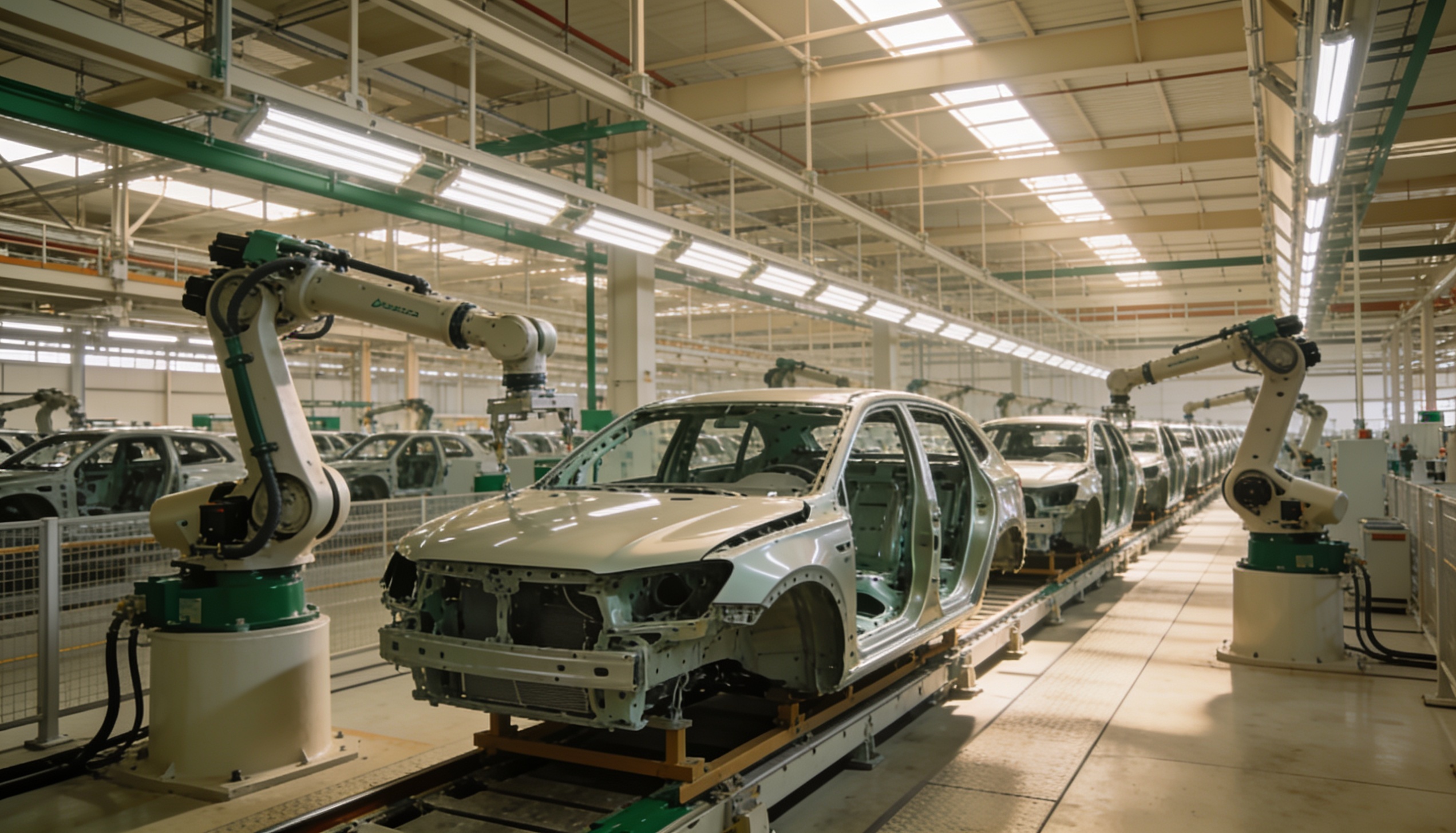
Africa's top — or co-top — producer
Morocco is now at the very top of African vehicle production. In 2024 it built 559,645 vehicles (OICA), drawing essentially level with South Africa's 599,755 — and reporting places Morocco overtaking South Africa in 2025. The trajectory is decisively upward: installed capacity is being rebuilt toward 1,000,000 vehicles a year, and the large majority of output is exported.
Two plants, two anchors
Renault (Tangier + Somaca Casablanca) produced a record 413,614 vehicles in 2024 — Tangier 312,381 (up 9%) plus Somaca 101,233 — with roughly 90% exported to 68 markets. The Tangier plant runs near its ~340,000/yr nameplate capacity, and added a 120,000/yr Dacia Jogger line carrying Morocco's first locally assembled hybrid — the first move up the powertrain ladder.
Stellantis (Kenitra) opened in 2019 at 200,000 vehicles/yr and is expanding toward 535,000/yr on a €1.2bn (~$1.4bn) investment, with micro-EV output (Citroën Ami, Opel Rocks-e, Fiat Topolino) scaling from 20,000 to 70,000 EVs/yr and a target of 75% local integration by 2030 plus 3,100 new in-house jobs.
The export weight
Automotive export turnover reached ~157.6bn MAD (~€15bn) in 2024, +6.3% year-on-year — Morocco's #1 export sector, ahead of phosphates (87.1bn MAD). Behind it sits an ecosystem of ~250 suppliers and 220,000+ jobs created between 2014 and 2021, with national local integration targeting 80% by 2030.
The EV-battery layer — the new part
The cluster is no longer just assembly. Gotion High-Tech and CDG are building Africa's first EV-battery gigafactory in Kenitra — phase-1 ~$1.3bn / 20 GWh, part of a $6.5bn agreement scaling to 100 GWh, with production targeted for Q3 2026 and ~2,300 direct jobs at phase-1, up to ~10,000 at full scale. Upstream, CNGR and Al Mada's COBCO joint venture at Jorf Lasfar began cathode-precursor (PCAM) production in January 2025, with planned capacity of 120,000 t/yr NCM and 60,000 t/yr LFP precursors — wiring Morocco's phosphate base into the battery supply chain.
What it means for property — Tangier and Kenitra
This is a workforce-demand thesis, not a price-momentum one. Stellantis adds 3,100 jobs and Gotion 2,300–10,000 — concentrated around Kenitra's Atlantic Free Zone — where apartments list in a ~600,000 to 1,500,000+ MAD band, accessible relative to the inbound industrial payroll. Tangier's case rests on Renault's depth: a 312,381-unit plant sustaining a permanent industrial labour base.
The honest counterweight: the national residential market is soft — transactions −14.5% year-on-year in Q1 2025, with Kenitra prices essentially flat. Industrial expansion is a demand tailwind into a market that is not, today, appreciating.
The honest ledger
What it proves:
- Morocco is at or near the top of African vehicle production, and automotive is its #1 export sector.
- Both flagship plants are expanding capacity, pushing installed capacity past 1M/yr.
- A genuine EV-battery supply chain is being built (gigafactory + precursor materials), not just assembly.
- Concrete, sizeable job creation is concentrated around Kenitra's Atlantic Free Zone.
What it still has to prove:
- That property prices in Tangier or Kenitra are rising — the broader market is contracting (−14.5% transactions, flat Kenitra prices).
- That announced gigafactory and expansion capacities are delivered on schedule (Gotion production is targeted for Q3 2026, not yet realised).
- A rental yield or rent level for the inbound workforce — only listing-price ranges are cited.
*Figures are sourced and adversarially fact-checked — the headline was corrected: Morocco drew level with South Africa in 2024 and overtook in 2025, not 2024. Forward-looking targets are commitments, not realised outcomes. Analysis, not investment advice.*
Is Morocco actually Africa's #1 car producer?
By OICA's 2024 actuals the two were effectively tied — Morocco 559,645 vehicles vs South Africa 599,755 — and reporting places Morocco overtaking South Africa in 2025. Either way Morocco is at the top of African production, with capacity being rebuilt toward 1,000,000 vehicles a year.
How big are the two main plants?
Renault's Moroccan operations (Tangier + Casablanca) made a record 413,614 vehicles in 2024 — Tangier alone 312,381, up 9% — near its ~340,000/yr capacity, ~90% exported to 68 markets. Stellantis Kenitra, opened 2019 at 200,000/yr, is expanding toward 535,000/yr on a €1.2bn investment.
What is the EV-battery angle near Kenitra?
Gotion High-Tech and CDG are building Africa's first EV-battery gigafactory in Kenitra — phase-1 ~$1.3bn/20 GWh, a $6.5bn agreement scaling to 100 GWh, production targeted Q3 2026. Upstream, CNGR/Al Mada's COBCO JV at Jorf Lasfar began cathode-precursor production in January 2025, with 120,000 t/yr NCM precursors planned.
How much does automotive matter to Morocco's economy?
It is the #1 export sector at ~157.6bn MAD (~€15bn) in 2024, +6.3% YoY, ahead of phosphates. It created 220,000+ jobs from 2014–2021 across ~250 suppliers, with local integration targeting 80% by 2030.
What does this mean for property in Tangier and Kenitra?
It is a workforce-demand thesis. Stellantis adds 3,100 jobs and Gotion 2,300–10,000 around Kenitra's Atlantic Free Zone, where apartments list at ~600,000–1,500,000+ MAD. But the national market is soft — transactions −14.5% YoY in Q1 2025 and Kenitra prices roughly flat — so industrial growth is a demand tailwind, not current price appreciation.