Morocco's green-energy engine and the southern property thesis
Morocco is concentrating solar, wind and green-hydrogen capex into its south — the 580 MW Noor Ouarzazate complex, a 2,373 MW wind fleet, the Offre Maroc hydrogen programme and a reality-checked Xlinks UK cable — against a 52%-by-2030 renewables target. For property it's an industrial-anchoring thesis centred on Dakhla, not yet a proven price signal.
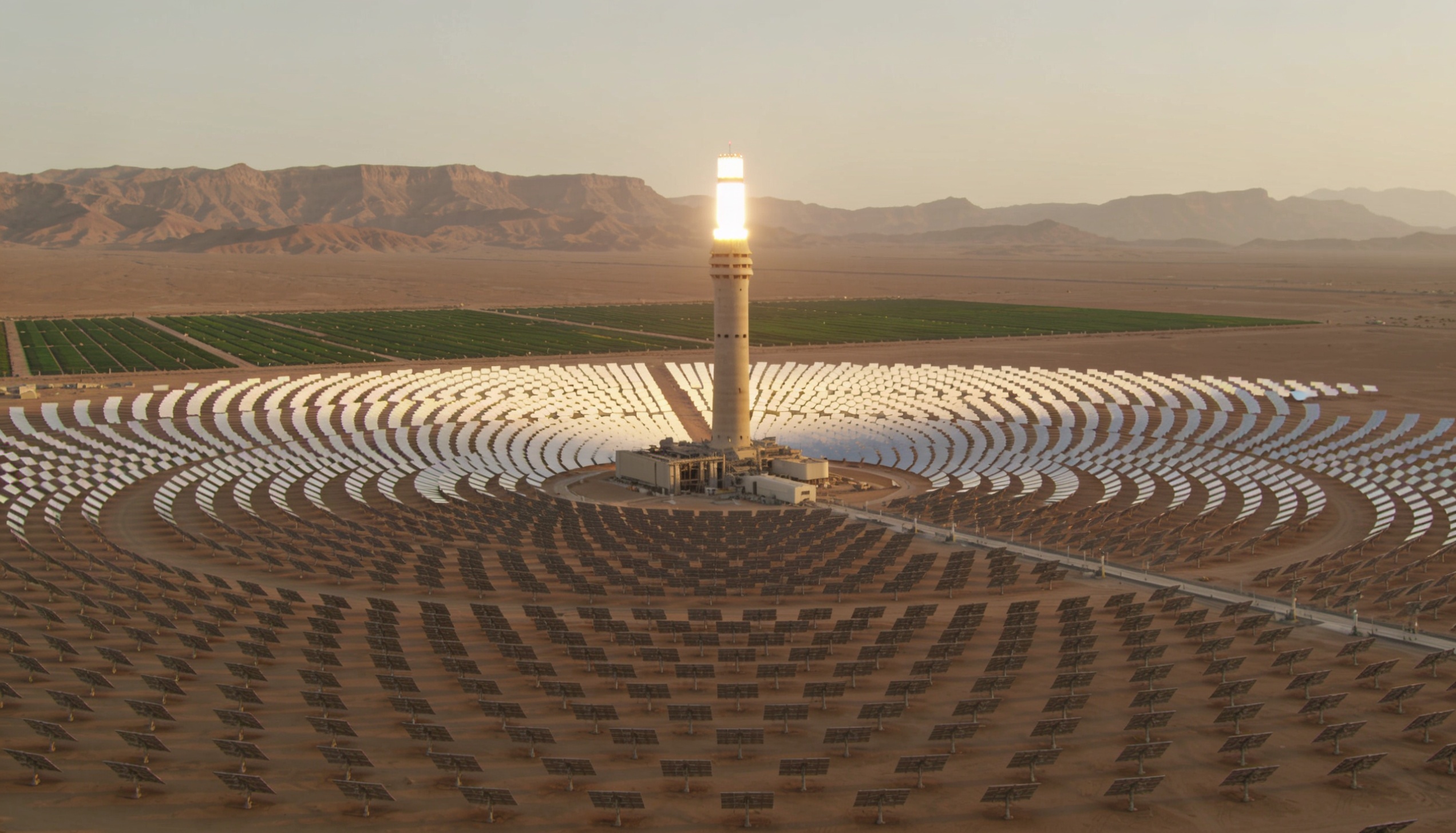
The anchor: Noor Ouarzazate
The Noor Ouarzazate Solar Complex is one of the world's largest concentrated-solar facilities — about 580 MW across four phases: Noor I (160 MW trough CSP, 2016), Noor II (200 MW, 2018), Noor III (150 MW tower CSP, 2018) and Noor IV (70 MW PV). It generates roughly 1.5 TWh of clean electricity a year — enough for around a million households — on a ~3,000 ha site northeast of Ouarzazate.
The next CSP step is Noor Midelt I, an 800 MW hybrid CSP-PV plant with storage, awarded to an EDF–Masdar–Green of Africa consortium at a then-record ~$71/MWh on a ~$785M investment.
The wind build-out
Installed wind capacity reached 2,373 MW by the end of 2024. The south carries a large share — Tarfaya (300 MW), Aftissat (200), Akhfenir (200), Laayoune (50) and Boujdour (300 MW, online since 2023) — with Tiskrad (100 MW) still to come.
The 2030 target
Morocco targets 52% of installed electricity capacity from renewables by 2030 (20% solar, 20% wind, 12% hydro); by mid-2025 it was around 45%. The 2025 NDC update goes further, aiming to roughly triple renewable capacity to over 15 GW by 2030.
Xlinks: the export-cable thesis — and its reality check
The Xlinks Morocco-UK project plans 11.5 GW of solar and wind plus storage in Guelmim-Oued Noun, exporting via a 3.6 GW HVDC subsea interconnector of ~3,800–4,000 km — which would be the world's longest undersea power cable, supplying up to 8% of UK electricity. But the export thesis is not yet bankable: in June 2025 the UK government declined to back the project, leaving its ~£24bn financing and 2031 first-power timeline uncertain. The Moroccan generation case is real; the cross-border offtake is not yet secured.
Offre Maroc: the green-hydrogen layer
Under "Offre Maroc," Morocco earmarked ~MAD 319bn (~$32–35bn) and selected five consortia for six flagship green-hydrogen projects in the southern provinces — ACWA Power, Nareva, ORNX (Ortus-Acciona-Nordex), TAQA-Moeve and a China Three Gorges-led group — chosen from ~40 bids across 17 countries. The strategy envisages ~6 GW of dedicated renewable capacity by 2030.
Two projects localise the thesis:
- Laayoune: ORNX signed a ~$4.5bn green-ammonia project — over 2 GW of wind+solar, ~900 MW of electrolysers and desalination, feeding ~560,000 t/yr of ammonia.
- Dakhla: a Morocco–UAE venture (Dahamco) plans ~$25bn of green hydrogen/ammonia, targeting 1 Mt/yr by 2031, with a ~$4bn first phase.
Why Dakhla leads for property
The Dakhla Atlantic Port (~650 ha, ~$1.2–1.6bn) is designed for ~35 Mt/yr and to act as a green-hydrogen export gateway, with ~1,000 ha of adjacent industrial zones. As an analytical framing — not a measured market — this concentrated capex anchors jobs, industrial land, port logistics and desalination across Dakhla (the strongest case), then Laayoune and Ouarzazate.
The honest ledger
What it proves:
- Real, operating renewable assets at scale — Noor Ouarzazate (~580 MW CSP) and a 2,373 MW wind fleet — with a credible 52%-by-2030 target (~45% already).
- A funded green-hydrogen programme (Offre Maroc, ~MAD 319bn) with named consortia and concrete southern projects (Laayoune ORNX, Dakhla Dahamco).
- A port-plus-zoned-land anchor in Dakhla that gives the southern property thesis a physical spine.
What it still has to prove:
- The export-cable story: the UK government declined to back Xlinks in June 2025 — the cross-border offtake is unproven.
- That announced hydrogen tonnages and 2030–2031 timelines are delivered — these are commitments, not outcomes.
- Any specific property price or yield in the south — the corridor thesis is an analytical framing, not a measured dataset, and the southern provinces are an earlier-stage frontier market.
*Figures are sourced and adversarially fact-checked — corrections applied: Noor output ~1.5 (not 1.8) TWh/yr; Boujdour wind is already operational; the UK declined to back Xlinks in June 2025. Forward-looking targets are commitments. Analysis, not investment advice.*
How big is Noor Ouarzazate and how much power does it produce?
It has about 580 MW of installed capacity across four phases and generates roughly 1.5 TWh of clean electricity a year — enough for around a million households — on a ~3,000 ha site northeast of Ouarzazate.
What is Morocco's renewable energy target?
Morocco targets 52% of installed electricity capacity from renewables by 2030 (20% solar, 20% wind, 12% hydro). By mid-2025 it was around 45%, and its 2025 NDC update aims to roughly triple renewable capacity to over 15 GW by 2030.
What is the Xlinks Morocco-UK Power Project — and is it happening?
It plans 11.5 GW of solar and wind plus storage in Guelmim-Oued Noun, exporting via a 3.6 GW HVDC subsea cable of ~3,800–4,000 km — which would be the world's longest undersea power cable, supplying up to 8% of UK electricity. But in June 2025 the UK government declined to back it, so its ~£24bn financing and 2031 first-power timeline are now uncertain.
What is 'Offre Maroc' for green hydrogen?
It is Morocco's green-hydrogen framework, earmarking ~MAD 319bn (~$32–35bn) and selecting five consortia for six flagship projects in the southern provinces, envisaging ~6 GW of dedicated renewables by 2030. Concrete projects include a ~$4.5bn green-ammonia plant at Laayoune (ORNX) and a ~$25bn hydrogen venture at Dakhla (Dahamco).
Which southern cities benefit most for property?
As an analytical framing, Dakhla leads — driven by its ~650 ha Atlantic port (~35 Mt/yr capacity), ~1,000 ha of zoned industrial land and a ~$25bn hydrogen venture. Laayoune (a ~$4.5bn green-ammonia project plus wind) and Ouarzazate (the Noor complex) follow. The south is an earlier-stage frontier market, not a measured price signal.