Tanger Med: Africa's largest port and the northern industrial corridor
Tanger Med crossed 10.24M TEU in 2024 and 11M+ containers in 2025 — Africa's largest container port — anchoring a 1,000+ company free-zone platform (~€14bn exports) and Morocco's #1-by-value EU automotive export position. For Tangier property: a real industrial-demand tailwind (transactions +23.3% YoY) — but a correlation, not a yield guarantee.
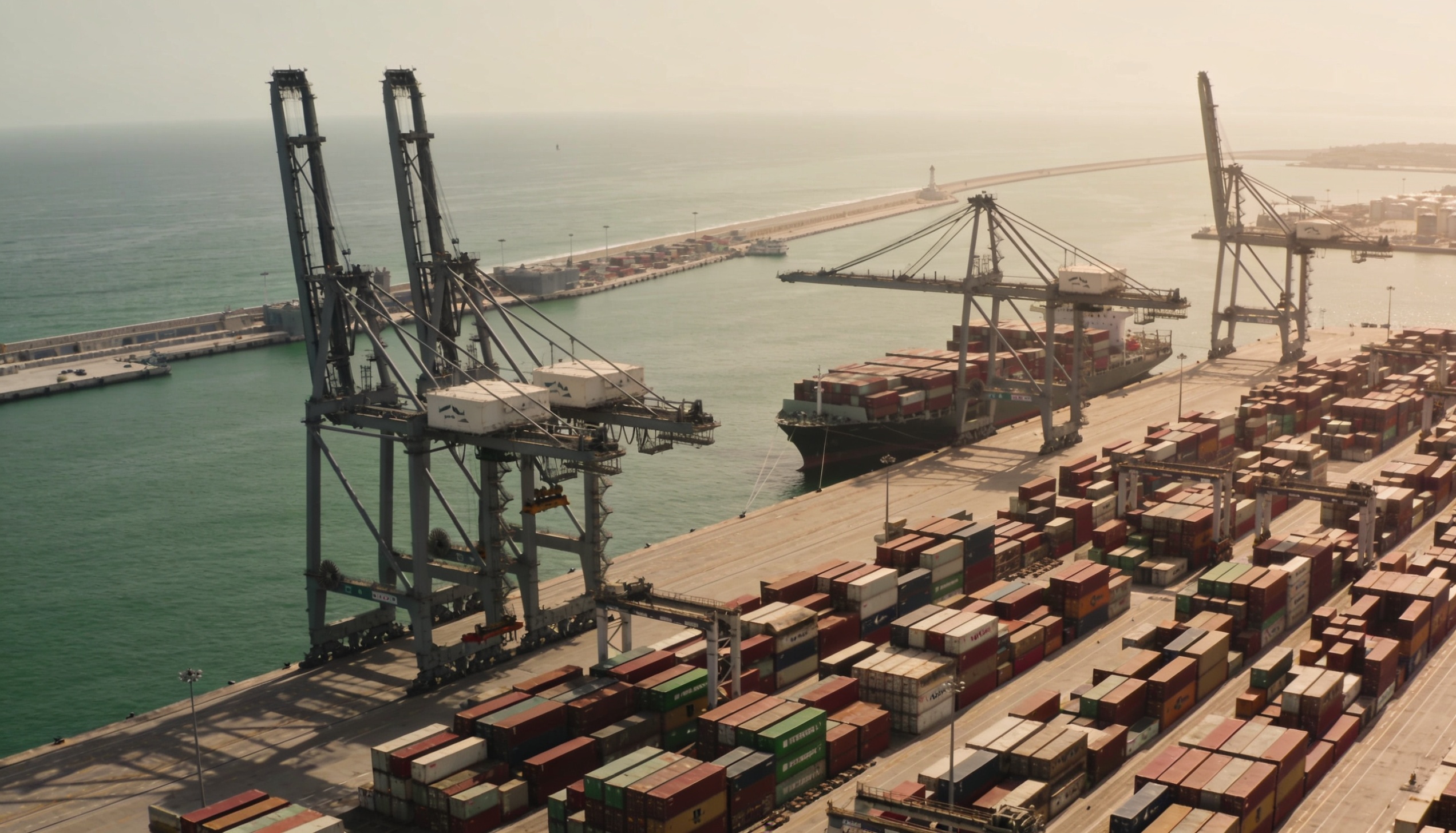
Throughput and capacity
Tanger Med handled a record 10.24 million TEU in 2024, up 18.8% — its first time past 10 million — and pushed beyond 11 million containers in 2025 (+8.4%), alongside over 161 million tonnes of goods across the complex. That runs at or above its stated nominal container capacity of ~9 million TEU (four terminals, 18 m draft, 3,600 m of quay; up to ~11M with full build-out) — the asset is near its design ceiling, not under-utilised. Globally it ranks 17th (Alphaliner) and connects to 180+ ports across 70 countries; group revenue passed ~$1.2 billion in 2024 (the port-authority entity alone is ~$400M).
Geography and the European link
The port sits ~14 km from Spain and ~40 km east of Tangier, on the Strait of Gibraltar — one of the world's busiest shipping lanes. Beyond containers it handles ~7 million passengers and ~700,000 trucks a year, a road-freight gateway to Europe as much as a transshipment hub.
The free zones and industrial platform
The economic zones are the second engine. More than 1,000 companies sit across the platform (Tanger Free Zone, Tanger Automotive City, Renault Tanger Med, Tetouan Shore/Park), generating ~€14 billion in annual export turnover across 3,000+ hectares — ranked the 2nd-best special economic zone in the world.
The automotive and export anchor
Automotive is the marquee cluster. Tanger Med processed ~601,000 vehicles in 2024, ~540,000 exported to Europe. Renault runs a dedicated terminal fed by its 300-ha plant in Melloussa. The macro effect: Morocco is the EU's largest automotive exporter by value (€15.1 billion), ahead of China and Japan, with anchors including Renault-Nissan, Valeo, APTIV, Sumitomo and Siemens Gamesa. The automotive free-zone area is being doubled, with a MAD 2.4 billion first tranche over 2024–2028.
The Tangier corridor and what it means for property
The industrial gravity shows up in capital flows: MAD 69 billion of investment entered the Tangier-Tetouan-Al Hoceima region in the first nine months of 2024. On the demand side, Tangier is one of Morocco's largest and fastest-growing metros. Residential transactions in Tangier grew strongly — +23.3% year-on-year in Q3 2025 (Bank Al-Maghrib / ANCFCC index), among the firmest in the country. Prime neighbourhoods (Malabata, Iberia, city centre) carry a clear premium, though precise per-m² figures come from single-source market references and should be treated as indicative.
Honest read
The port-to-property thesis is directionally supported but not closed. Throughput, free-zone scale and automotive exports are hard, sourced numbers. The housing signal is real but narrower than headline guides suggest — and the causal chain from container volume to rental yield or capital gain is inferred, not measured. (Some widely-circulated Tangier figures conflate national tourism and price data with the city; we've dropped those.) Treat the corridor as a structural demand tailwind — not a yield guarantee.
The honest ledger
What it proves:
- Tanger Med operates at record scale (10.24M TEU 2024, >11M containers 2025), at or above nominal capacity.
- The free-zone platform is materially large (1,000+ companies, ~€14bn export turnover) and automotive-anchored (~601k vehicles, €15.1bn EU auto exports).
- The Tangier corridor is attracting heavy investment (MAD 69bn in 9M 2024).
- Tangier residential transactions are growing strongly (+23.3% YoY, Q3 2025, official index).
What it still has to prove:
- A direct causal link between port throughput and specific property returns — the connection is correlational, not measured.
- Durable price growth — reliable per-m² price data is thin and single-sourced; some circulating figures conflate national data with Tangier.
- Forward capacity headroom — throughput already runs at/above nominal capacity, so growth depends on terminal build-out cited only as a range.
- Asset-level outcomes for any individual buyer.
*Figures are sourced and adversarially fact-checked — corrections applied: the $1.2bn revenue is group (authority ~$400M); transaction growth is the official +23.3% (Q3 2025), not a guide's +14–15%; refuted Tangier price/population/tourism specifics were dropped. Analysis, not investment advice.*
How much cargo does Tanger Med handle?
In 2024 it handled a record 10.24 million TEU (+18.8%), then exceeded 11 million containers in 2025 (+8.4%), plus over 161 million tonnes of goods. Group revenue passed ~$1.2 billion in 2024 (the port-authority entity alone is ~$400M).
Is Tanger Med the largest port in Africa?
It is Africa's largest container port by capacity and ranks 17th worldwide (Alphaliner), connecting to 180+ ports across 70 countries. Nominal container capacity is ~9 million TEU, with build-out potential cited up to ~11M — so it already runs at or above nameplate.
Why does Tanger Med matter for cars?
It processed ~601,000 vehicles in 2024 (~540,000 exported to Europe) and anchors Morocco's position as the EU's largest automotive exporter by value (€15.1 billion). Renault runs a dedicated terminal fed by its 300-ha Melloussa plant, and the automotive free-zone area is being doubled with a MAD 2.4 billion first tranche over 2024–2028.
What are the Tanger Med free zones?
An industrial platform spanning 3,000+ hectares hosting 1,000+ companies (Renault-Nissan, Valeo, APTIV, Sumitomo, Siemens Gamesa), generating ~€14 billion in annual export turnover — ranked the 2nd-best special economic zone in the world.
How does the port affect property in Tangier?
The corridor drew MAD 69 billion of regional investment in the first nine months of 2024, and Tangier residential transactions grew strongly — +23.3% year-on-year in Q3 2025 (official Bank Al-Maghrib / ANCFCC index). But the link from port throughput to specific property returns is correlational, not measured, and reliable per-m² price data is thin — treat the corridor as a demand tailwind, not a yield guarantee.